-
Introduction: Fluency Awareness
The activities here aim to help you become aware of the elements that influence your fluency and their importance.
- Fluency: Steps to develop your fluency- Part 1
- Fluency: Steps to develop your fluency- Part 2
- Fluency: Steps to develop your fluency- Part 3
- The importance of improving your vocabulary
- Planning your Vocabulary Learning Road Map: Knowledge of Vocabulary
- The importance of improving your structure
- Planning your Structure Learning Road Map: Knowledge of Structure
- The importance of improving your pronunciation
- Planning your Pronunciation Learning Road Map: Knowledge of Pronunciation
- Suggestions to Improve your Speaking
-
Knowledge- Test and Practice your Knowledge of Vocabulary
Here you are going to be able to 'test' your knowledge so that you know which areas you need to work more.
- Knowledge of vocabulary- Words and Phrases related to Daily Life
- “Eating out”: Video- Basic words and phrases related to Daily Life
- “Routine”- Common Daily Expressions- Video
- Knowledge of Vocabulary- Words and Phrases related to technology
- “Technology”: Video-Basic words and phrases related to Technology
- Knowledge of vocabulary- Words and Phrases related to specific professions
- “Dr.Henderson”- Words and Phrases related to specific professions- Medicine
- “Museum of the Future”- Words and Phrases related to specific professions- Architecture
- “Eco-Friendly Architecture”- Words and Phrases related to specific professions- Architecture
- “Feng Shui”: Your Life in Perfect Harmony- Words and Phrases related to specific professions- Interior Design
- “Feng Shui” : The Bedroom-Video-Words and Phrases related to specific professions- Interior Design
- “Feng Shui”- The Bedroom- Words and Phrases related to specific professions- Interior Design
- Knowledge of vocabulary- Words and Phrases Commonly used in Academic Settings
- Knowledge of Vocabulary- Synonyms and Antonyms
- Knowledge of Vocabulary- Phrasal Verbs
- Phrasal Verbs: meanings and types
- Phrasal Verbs: Separability
- Phrasal Verbs- Video
- Knowledge of Vocabulary- Idioms and slangs
- Navigating Idioms 1- Vocabulary Focus
- Navigating Idioms 2- Vocabulary Focus
- Navigating Slangs 1- Vocabulary focus
- Navigating Slangs 2- Vocabulary Focus
- Describing Trends- Idioms and Slang- Vocabulary Focus
- Tips to help you expand your vocabulary
- “Be a successful non-native speaker”- Reflection Focus
-
Knowledge: Practice your Pronunciation
Here you will be able to practice the areas of pronunciation that might affect your fluency.
- What does pronunciation involve?
- Intonation- What languages sound like
- Intonation- How Intonation Changes Meaning
- Intonation- The Main English Intonation Patterns
- Intonation- Breaking the Accent Barrier 1
- Word Stress
- Word Stress- Quiz
- Sentence Stress
- Sentence Stress – Quiz
- Linking
- Linking – Quiz
- Linking Words- Part 1- Same Consonant Sounds
- Linking Words- Part 2- Similar Consonant Sounds
- Linking Words- Part 3- Consonant and Vowel Sounds
- Linking Sounds- final /n/
- Phonemic chart
- The final (-ed) of the regular past tense verbs
- The voiced “th” / ð / sound
- The voiceless “th” /θ/ sound
- The Long /i:/ and Short /ɪ/ Sounds
- The short “o” /ɑ/ sound
- The long “o” /oʊ/ sound
- The /ɔɪ / sound
- Tongue twisters to improve your pronunciation
-
Knowledge- Test and Practice your Knowledge of Grammar
- Architecture: Contextual Reference -“The Cradle”
- Knowledge of Structure- Verb Tenses- Test your knowledge
- Verb Tenses Quiz 1
- Verb Tenses in English: General Overview
- Verb Tenses Quiz 2
- Verb Tenses in English: Simple Tenses
- Verb Tenses in English: Continuous Tenses
- Verb Tenses in English: Perfect Tenses- Present Perfect
- Verb Tenses in English: Perfect Tenses- Past Perfect
- Expressing the Future
- Future in the Past
- Knowledge of Structure- Modal Verbs
- Tenses: Concept Questions
- Modal Verbs
- Knowledge of Structure- Conditionals
- Conditionals
- Knowledge of structure- Relative Clauses
- Relative Clauses
- Knowledge of Structure- Reported Speech
- Reported Speech- General Guidelines
- Knowledge of Structure- Passive Voice
- Passive Voice
-
Conversation 1: Functional Language
- Daily Conversations: Checking for understanding
- Daily Conversations- Agree and Disagree- Function Focus
- Daily Conversations- Polite Interruptions- Function Focus
- Daily Conversations: Asking for Information
- Asking for Information: Indirect Questions Part 1
- Asking for Information: Indirect Questions Part 2
- Asking for Information: Indirect Questions Part 3
- Asking short and gentle questions: Presenting Complaint-Medicine- Topic Focus
- Asking short and gentle questions: Types of Questions- Presenting Complaints- Medicine-Grammar Focus
- Asking short and gentle questions: Tenses- Presenting Complaints- Medicine- Grammar Focus
- Asking and Answering Questions:”Taking a Patient’s history”- Authentic Video- Listening- Medicine Focus
- “The First Heart Transplant”- Listening-Medicine- Specific Focus
- Agreeing and Disagreeing-must-know expressions- video
- Complaining or not Complaining?: Customer Service
-
Conversation 2: Speak Up
- Life Skills Focus: “Becoming more self-aware” 1
- Life Skill Focus: “Becoming more self-aware” 2
- Language and Beyond Focus: “Consider the consequences of your actions”
- “Bridging the generation gap”
- Protegido: “Less than One”: Short Film
- “The logical song” by Supertramp 1
- “The Logical Song” by Supertramp 2
Sentence Stress
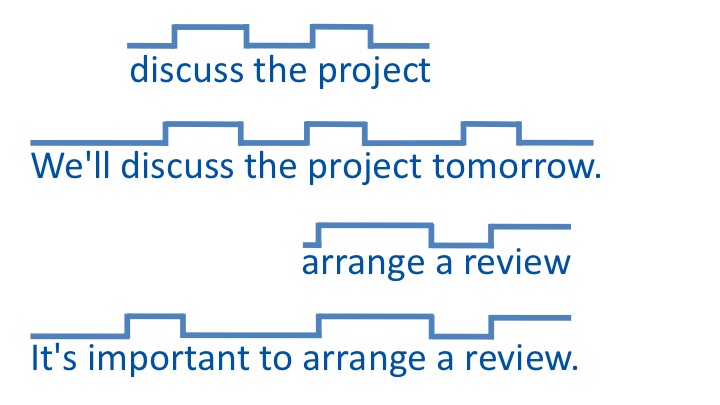
Sentence stress is the music of spoken English. Like word stress, sentence stress can help you to understand spoken English, even rapid spoken English.
Sentence stress is what gives English its rhythm or “beat”. You remember that word stress is accent on one syllable within a word. Sentence stress is accent on certain words within a sentence.
Most sentences have two basic types of word:
-
- content words
Content words are the key words of a sentence. They are the important words that carry the meaning or sense—the real content. - structure words
Structure words are not very important words. They are small, simple words that make the sentence correct grammatically. They give the sentence its correct form—its structure.
- content words
If you remove the structure words from a sentence, you will probably still understand the sentence.
If you remove the content words from a sentence, you will not understand the sentence. The sentence has no sense or meaning.
Imagine that you receive this telegram message:
Sentence Stress- Keywords
This sentence is not complete. It is not a “grammatically correct” sentence. But you probably understand it. These 4 words communicate very well. Somebody wants you to sell their car for them because they have gone to France. We can add a few words:
Sentence Stress- keywords and function words
The new words do not really add any more information. But they make the message more correct grammatically. We can add even more words to make one complete, grammatically correct sentence. But the information is basically the same:
Sentence Stress with Structure Words
In our sentence, the 4 key words (sell, car, gone, France) are accentuated or stressed.
Why is this important for pronunciation? It is important because it adds “music” to the language. It is the rhythm of the English language. It changes the speed at which we speak (and listen to) the language. The time between each stressed word is the same.
Sentence Stress Rules
The basic rules of sentence stress are:
-
- content words are stressed
- structure words are unstressed
- the time between stressed words is always the same
The following tables can help you decide which words are content words and which words are structure words:
Content words – stressed
| words carrying the meaning | example |
| main verbs | SELL, GIVE, EMPLOY |
| nouns | CAR, MUSIC, MARY |
| adjectives | RED, BIG, INTERESTING |
| adverbs | QUICKLY, WHY, NEVER |
| negative auxiliaries | DON’T, AREN’T, CAN’T |
Structure words – unstressed
| words for correct grammar | example |
| pronouns | he, we, they |
| prepositions | on, at, into |
| articles | a, an, the |
| conjunctions | and, but, because |
| auxiliary verbs | do, be, have, can, must |
Exceptions
The rules above are for for what is called “neutral” or normal stress. But sometimes we can stress a word that would normally be only a structure word, for example to correct information. Look at the following dialogue:
“No, THEY haven’t, but WE have.”
Note also that when “be” is used as a main verb, it is usually unstressed—even though as a main verb it is also a content word.