
Sentence Stress
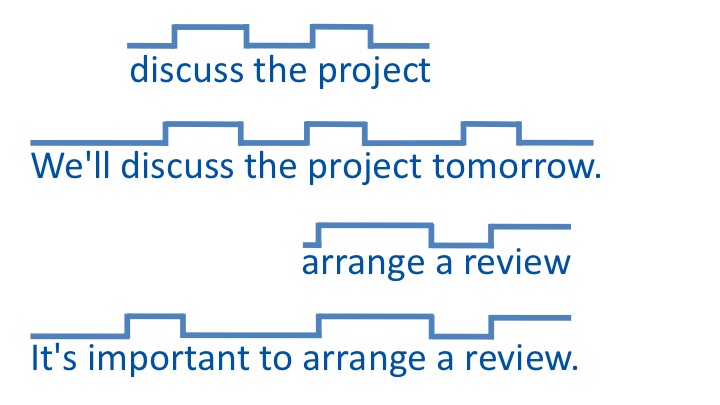
Sentence stress is the music of spoken English. Like word stress, sentence stress can help you to understand spoken English, even rapid spoken English.
Sentence stress is what gives English its rhythm or “beat”. You remember that word stress is accent on one syllable within a word. Sentence stress is accent on certain words within a sentence.
Most sentences have two basic types of word:
-
- content words
Content words are the key words of a sentence. They are the important words that carry the meaning or sense—the real content. - structure words
Structure words are not very important words. They are small, simple words that make the sentence correct grammatically. They give the sentence its correct form—its structure.
- content words
If you remove the structure words from a sentence, you will probably still understand the sentence.
If you remove the content words from a sentence, you will not understand the sentence. The sentence has no sense or meaning.
Imagine that you receive this telegram message:
Sentence Stress- Keywords
This sentence is not complete. It is not a “grammatically correct” sentence. But you probably understand it. These 4 words communicate very well. Somebody wants you to sell their car for them because they have gone to France. We can add a few words:
Sentence Stress- keywords and function words
The new words do not really add any more information. But they make the message more correct grammatically. We can add even more words to make one complete, grammatically correct sentence. But the information is basically the same:
Sentence Stress with Structure Words
In our sentence, the 4 key words (sell, car, gone, France) are accentuated or stressed.
Why is this important for pronunciation? It is important because it adds “music” to the language. It is the rhythm of the English language. It changes the speed at which we speak (and listen to) the language. The time between each stressed word is the same.
Sentence Stress Rules
The basic rules of sentence stress are:
-
- content words are stressed
- structure words are unstressed
- the time between stressed words is always the same
The following tables can help you decide which words are content words and which words are structure words:
Content words – stressed
| words carrying the meaning | example |
| main verbs | SELL, GIVE, EMPLOY |
| nouns | CAR, MUSIC, MARY |
| adjectives | RED, BIG, INTERESTING |
| adverbs | QUICKLY, WHY, NEVER |
| negative auxiliaries | DON’T, AREN’T, CAN’T |
Structure words – unstressed
| words for correct grammar | example |
| pronouns | he, we, they |
| prepositions | on, at, into |
| articles | a, an, the |
| conjunctions | and, but, because |
| auxiliary verbs | do, be, have, can, must |
Exceptions
The rules above are for for what is called “neutral” or normal stress. But sometimes we can stress a word that would normally be only a structure word, for example to correct information. Look at the following dialogue:
“No, THEY haven’t, but WE have.”
Note also that when “be” is used as a main verb, it is usually unstressed—even though as a main verb it is also a content word.